As Richard Mayhew notes, terror attacks are fundamentally attacks borne of weakness. ISIS has no armored divisions massed on the Turkish border. ISIS is not and never has been a fundamental threat. The absolute horror of the Nice attacks derives from the chaotic unpredictability of it. More Americans will commit suicide today than died in Nice. And the day after that. And the day after that. But suicides are personal and private (usually) and their audience is limited, if it exists at all.
Terrorism is grisly theater. It is intended for public consumption. And mostly, it is intended to create a reaction. Sadly, Trump and the current GOP is making C+ Augustus look like B+ Augustus. Dubya never equated 9/11 with Islam. He made a conscious effort to divorce the acts of terrorism from the religion of the perpetrators. Trump and his minions and fellow travelers are falling over themselves to initiate new bans on Muslims. Gingrich latest emetic offering is to round up all Muslims and then ask them if they believe in Sharia law. If they do, deport them.
Basically, Gingrich wants to recruit for ISIS.
If I am a radical or angry Muslim American, I simply lie about Sharia (permitted in Islamic tradition) and then shot up a shopping mall at Christmas. Secondly, Sharia law isn't Islamism, and certainly not radical, Salafist Islamism. Sharia is simply religious rules for daily life. What constitutes Halal food? Who gets what in a divorce? Can I charge interest on a loan to a non-Muslim? Yes, there are parts of Sharia that we rightly consider barbaric - chopping off the hands of thieves, flogging rape victims for adultery. Most of the awful aspects of Sharia are tied up in the unique religious-political system of Saudi Arabia. No one in the US is using Sharia law to flog an adulterer.
The Right Wing fixation on Sharia is the sort of mind-numbingly stupid oversimplification of issues that should reasonably disqualify Republicans from being allowed to make complicated decisions from the Oval Office. Republicans are no longer capable or allowed to make complicated and nuanced decisions. They have been reduced to reflexive tics that come out like Tourettes: BENGHAZI! SHARIA! EMAILS! FAST AND FURIOUS!
This is how Trump was able to takeover the Republican Party. Either by design or by accident, he tapped into the stupidity - and that's the word, sorry if that's elitist - of a Republican base that is incapable of holding contradictory ideas in its head. "You hate these people, I hate these people."
The Nice attacks are a horror show. But they are also an example of the fundamental weakness of ISIS and their strain of Takfir violence. ISIS has lost Fallujah. They are losing Ramadi and Mosul. They are being rolled back in Syria.
But their strain of anti-Western nihilism is still laying there for any angry Muslim to pick up and use. The solution is to stop alienating Muslims who live in the West and discredit ISIS by destroying their "caliphate" but to destroy it without invading another Arab country. It is not to give in to fear and hatred.
Friday, July 15, 2016

Thursday, July 14, 2016
Wednesday, July 13, 2016
David Cameron's Legacy
As he leaves office, it's proper to reflect on Cameron's PM-ship.
He was telegenic and charming. His PM questions were great.
But he oversaw austerity, Libya (largely an Anglo-French affair) and Brexit. Not sure Britain is losing much.
Tuesday, July 12, 2016
Who Is Hillary Clinton?
Ezra Klein has a pretty good answer.
Also, now that Sanders has endorsed Clinton, we will see that quite a few of the Bernie or Bust crowd was really about hating Clinton. It always has been.
Also, now that Sanders has endorsed Clinton, we will see that quite a few of the Bernie or Bust crowd was really about hating Clinton. It always has been.
Monday, July 11, 2016
Baton Rouge vs Dallas
In the aftermath of the terrible shootings in Dallas, several figures - including the Dallas Chief of Police and the mayor - have done very well in how they handled the political ramifications of the attack on Dallas police. Namely, they downplayed the politics. They treated it as a crime and the perpetrator as a criminal. Most importantly, they understood that the peaceful protesters were citizens of Dallas and potential victims of violence, too. Several cities have done similar good work in making sure that protests don't become violent, even if there are provocative acts within a small number of the protesters.
And then you have Baton Rouge.


And then you have Baton Rouge.
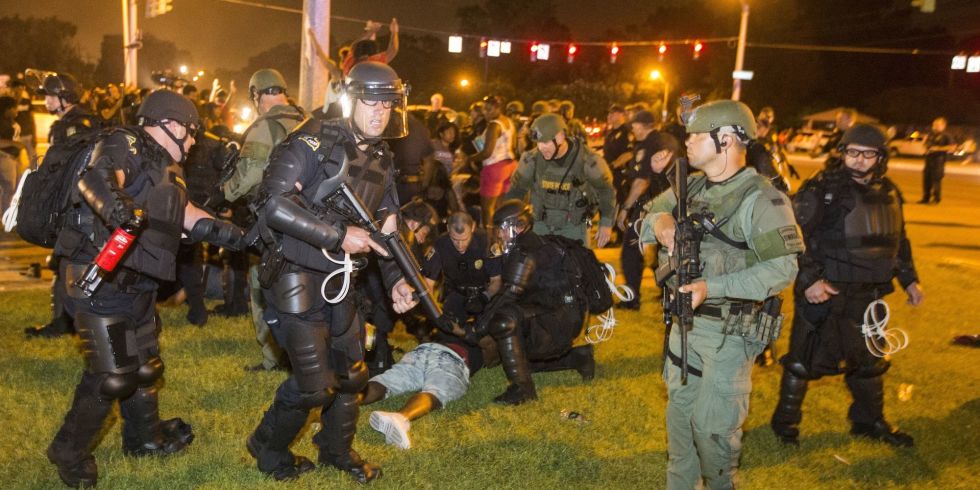

One would have thought that a singular lesson of Ferguson was to avoid having your mostly or all white police force look like an occupying army.

One would have been wrong.
It does seem that some on the Libertarian Right are willing to engage on the issue of the over-militarization of our police force. But the Authoritarian Right - as typified by the GOP nominee - is more than cool with this.
Again, it goes back to the intersection of racism and too many guns.
But our salvation as a nation is only going to come when we stop treating our own population as the enemy.
Sunday, July 10, 2016
Saturday, July 9, 2016
Is This 1968 All Over Again?
No.
Maybe.
As Josh Marshall notes, maybe this is 1967, the bloody lead-up to the social disintegration of 1968.
I think we might be more resilient that 1968, because at least we aren't mired in Vietnam and America is more diverse. But that diversity is what drives Trumpism. That Trumpism seems to have a ceiling of about 30% (with the rest of his support coming from people who are simply opposed to HRC or loyal Republicans) is heartening.
My worry remains two-fold.
First, Trump will continue to do and say things that are outrageous and break the rules and norms of political discourse in their country. He will normalize the abnormal. As of now, the Black Lives Matter movement has vehemently rejected violence and I don't expect that to change. But that leads to my second worry.
We live in a time where the demonstrations of Sandy Hook, San Bernadino, Orlando and now Dallas show that any long asshole can sufficiently arm themselves in a way that can cause mass casualties. There are some heartening signs in the aftermath of Dallas - Newt Gingrich and Paul Ryan both made very eloquent statements about the disadvantages of being black in America - but how many more angry men will take matters into their own hands.
I fear that it is almost certain that a politician will be assassinated this year. Maybe not of the stature of King or Bobby Kennedy, but someone, somewhere.
Is it 1968? No. Maybe.
Maybe.
As Josh Marshall notes, maybe this is 1967, the bloody lead-up to the social disintegration of 1968.
I think we might be more resilient that 1968, because at least we aren't mired in Vietnam and America is more diverse. But that diversity is what drives Trumpism. That Trumpism seems to have a ceiling of about 30% (with the rest of his support coming from people who are simply opposed to HRC or loyal Republicans) is heartening.
My worry remains two-fold.
First, Trump will continue to do and say things that are outrageous and break the rules and norms of political discourse in their country. He will normalize the abnormal. As of now, the Black Lives Matter movement has vehemently rejected violence and I don't expect that to change. But that leads to my second worry.
We live in a time where the demonstrations of Sandy Hook, San Bernadino, Orlando and now Dallas show that any long asshole can sufficiently arm themselves in a way that can cause mass casualties. There are some heartening signs in the aftermath of Dallas - Newt Gingrich and Paul Ryan both made very eloquent statements about the disadvantages of being black in America - but how many more angry men will take matters into their own hands.
I fear that it is almost certain that a politician will be assassinated this year. Maybe not of the stature of King or Bobby Kennedy, but someone, somewhere.
Is it 1968? No. Maybe.
Friday, July 8, 2016
Compare And Contrast
"Some people" have responded to the tragedy by embracing language of exclusion and dripping with white privilege. Seriously, if you are still confused about white privilege, read this:
I grew up in a world — I've been around long enough that we always had bad people, we always had dangerous people, but the general public respected police.
Yeah, respected....terrified of...those are so hard to keep distinct.
On the other hand, "some people" think we should try and heal our broken country. Some people learned something from history.
We've got to turn to love. We have to stop shooting. We have got to turn to love. We cannot bring about justice through violence. We cannot bring about love through violence. If we continue to turn to violence, we are going to continue to see heartache and devastation.
I want to come together in common ground. I mean Newt Fucking Gingrich has basically come out and said, "Yeah, it sucks to be black, and we need to understand that." Newt Gingrich.
But as long as suppurating hemorrhoids like Dan Patrick are out there? Tough to come together.
I grew up in a world — I've been around long enough that we always had bad people, we always had dangerous people, but the general public respected police.
Yeah, respected....terrified of...those are so hard to keep distinct.
On the other hand, "some people" think we should try and heal our broken country. Some people learned something from history.
We've got to turn to love. We have to stop shooting. We have got to turn to love. We cannot bring about justice through violence. We cannot bring about love through violence. If we continue to turn to violence, we are going to continue to see heartache and devastation.
I want to come together in common ground. I mean Newt Fucking Gingrich has basically come out and said, "Yeah, it sucks to be black, and we need to understand that." Newt Gingrich.
But as long as suppurating hemorrhoids like Dan Patrick are out there? Tough to come together.
The Common Weal
We are losing our sense of what it means to be a country, a nation.
The centrifugal forces on our politics have created a moment that is genuinely dangerous.
Nations and states don't just happen; they are acts of will and planning. When we created our form of government in 1787, it was an act of will that many people resisted. But eventually, we came to accept the Constitution, for all its flaws. We set about trying to create a "more perfect Union." It was not always a smooth or steady process, but the arch of the universe and all that.
When we create a government, we invest that government with a monopoly of violence. That's Max Weber's term, and it means that we cede to the state the ability to enforce laws, even unto death. But that "violence" could presumably apply to property, too. We cede to the state the ability to seize our property in the form of taxation.
This is necessary for governments to function. The alternative is anarchy.
The rhetoric of America has spun into the realm of anarchy. Much of that rhetoric exists on the Right, from the Bundys to the NRA saying we need guns to protect ourselves from the government. The Libertarian Right has - as its model - the idea that each citizen stands apart and "free" from the state. Frankly, the Anarchist Left has the same model.
I'm not trying to engage in false equivalencies here, but once you undermine the legitimacy of the state, you unleash all sorts of shit.
The language on the Right of Armed Rebellion and on the Left of Revolution is a language that undermines the legitimacy of the state. I can't count how many times I've heard the phrase "all politics is corrupt" or "they're all terrible in Washington." That's cheap cynicism, but it's also terribly erosive to the common weal, the common good.
The roots of this, I do believe, lie predominantly with the Tea Party. Their entire genesis was a resistance to the idea that the federal government should do much of anything beyond national security. The anti-government rhetoric was matched by a complete resistance to the idea of governing. At least we are currently not about to default on our debt, but it was touch and go. Remember at least a few Tea Party politicians embraced the Bundys at first.
The ideologues on the Right have now been met by ideologues on the Left. As I've written elsewhere, their constant attacks on Hillary Clinton are really just an attack on centrist government. Some of that attack is marinated in an unacknowledged sexism, but it is also a by-product of the idea that "we need a revolution" that Sanders promulgated. I know Sanders was not talking about killing police officers. But revolutions involve killing police officers. Not the kind he was talking about, but that rhetoric, once it leaves his rally can latch on to some angry or deranged man with powerful weaponry.
An assault on police officers is an assault on the ability of the state to perform its most essential task: the maintenance of order. The war of attrition waged against black men that I wrote about yesterday also erodes the ability of the state to maintain order. As Deray McKesson said when he spoke at our school: "We don't hate police, we just want them to stop killing us." As a white person, I don't trust the police necessarily, but I don't mistrust them either. If I was black, I would actively mistrust them, and frankly, I would have reason to do so. That has to change or there will be more Dallases.
Governments are built on institutions. Many of those institutions are informal. They are things we agree to do in order to serve the common weal. Many of those norms in Congress were destroyed by the Tea Party. They were attacked by groups like the Bundys. They are now under assault from men with heavy weaponry.
Our institutions - our boring, conservative institutions - are shaking under our feet. We have a candidate for President who routinely violates those norms. Every day, he says or does something that would have been beyond the Pale a year ago. There is a cost to that. I do not think Trump can win election. But I think he can continue this pattern of tearing apart the fabric of our society by repeatedly shredding the norms and boundaries we have erected for ourselves over the years.
Do you want to know what pulling down the edifices of government really looks like? Look at Baton Rouge, look at Minneapolis, but really look at Dallas.
In November, 1963, in Dallas, we saw a similar assault on our collective life. While great and positive change came in the next few years, by 1968, the country was on the brink of anarchy.
How about we not do that?
The centrifugal forces on our politics have created a moment that is genuinely dangerous.
Nations and states don't just happen; they are acts of will and planning. When we created our form of government in 1787, it was an act of will that many people resisted. But eventually, we came to accept the Constitution, for all its flaws. We set about trying to create a "more perfect Union." It was not always a smooth or steady process, but the arch of the universe and all that.
When we create a government, we invest that government with a monopoly of violence. That's Max Weber's term, and it means that we cede to the state the ability to enforce laws, even unto death. But that "violence" could presumably apply to property, too. We cede to the state the ability to seize our property in the form of taxation.
This is necessary for governments to function. The alternative is anarchy.
The rhetoric of America has spun into the realm of anarchy. Much of that rhetoric exists on the Right, from the Bundys to the NRA saying we need guns to protect ourselves from the government. The Libertarian Right has - as its model - the idea that each citizen stands apart and "free" from the state. Frankly, the Anarchist Left has the same model.
I'm not trying to engage in false equivalencies here, but once you undermine the legitimacy of the state, you unleash all sorts of shit.
The language on the Right of Armed Rebellion and on the Left of Revolution is a language that undermines the legitimacy of the state. I can't count how many times I've heard the phrase "all politics is corrupt" or "they're all terrible in Washington." That's cheap cynicism, but it's also terribly erosive to the common weal, the common good.
The roots of this, I do believe, lie predominantly with the Tea Party. Their entire genesis was a resistance to the idea that the federal government should do much of anything beyond national security. The anti-government rhetoric was matched by a complete resistance to the idea of governing. At least we are currently not about to default on our debt, but it was touch and go. Remember at least a few Tea Party politicians embraced the Bundys at first.
The ideologues on the Right have now been met by ideologues on the Left. As I've written elsewhere, their constant attacks on Hillary Clinton are really just an attack on centrist government. Some of that attack is marinated in an unacknowledged sexism, but it is also a by-product of the idea that "we need a revolution" that Sanders promulgated. I know Sanders was not talking about killing police officers. But revolutions involve killing police officers. Not the kind he was talking about, but that rhetoric, once it leaves his rally can latch on to some angry or deranged man with powerful weaponry.
An assault on police officers is an assault on the ability of the state to perform its most essential task: the maintenance of order. The war of attrition waged against black men that I wrote about yesterday also erodes the ability of the state to maintain order. As Deray McKesson said when he spoke at our school: "We don't hate police, we just want them to stop killing us." As a white person, I don't trust the police necessarily, but I don't mistrust them either. If I was black, I would actively mistrust them, and frankly, I would have reason to do so. That has to change or there will be more Dallases.
Governments are built on institutions. Many of those institutions are informal. They are things we agree to do in order to serve the common weal. Many of those norms in Congress were destroyed by the Tea Party. They were attacked by groups like the Bundys. They are now under assault from men with heavy weaponry.
Our institutions - our boring, conservative institutions - are shaking under our feet. We have a candidate for President who routinely violates those norms. Every day, he says or does something that would have been beyond the Pale a year ago. There is a cost to that. I do not think Trump can win election. But I think he can continue this pattern of tearing apart the fabric of our society by repeatedly shredding the norms and boundaries we have erected for ourselves over the years.
Do you want to know what pulling down the edifices of government really looks like? Look at Baton Rouge, look at Minneapolis, but really look at Dallas.
In November, 1963, in Dallas, we saw a similar assault on our collective life. While great and positive change came in the next few years, by 1968, the country was on the brink of anarchy.
How about we not do that?
Thursday, July 7, 2016
The War Of Attrition On Black Men Is Uniquely American
Two days, two more police killings of black men who should not have been killed. Inevitably, the outrage, anger and hurt of some Americans is met with the defensiveness of other Americans. Both men had guns on them, neither men was brandishing those guns or pointing them at officers. Compare this to the treatment the Bundy Gang demonstrated or the way police treated Dylan Roof, and the rage of African Americans and the anger and bewilderment of many white Americans is completely understandable.
Inevitably, though, you find those people who will say that Alton Sterling was a sex offender (he had sex with a 17 year old as a 21 year old). That he was carrying a gun. That he was breaking the law by selling those CDs. The idea that this would carry a death sentence never seems to occur to them. And the evidence is overwhelming that that death sentence was leveled because of the color of his skin. Philando Castile had a licensed firearm on him, was not reaching for it and was shot four times.
In TRYING to be objective, it occurs to me that these shootings are uniquely American for several reasons.
First, there are too many goddamned guns. Both Castile and Sterling had legal weapons on them. If you're a police officer, every single encounter you have in the course of a day's work could become a shoot out. They almost never do, but they could. And that's because we are awash in weaponry. That makes every encounter potentially lethal and ups the stakes, ups the tension of a police officer's job. Fear makes you stupid.
Second, you're goddamned right it's about race. White people see threats in black people that simply don't exist. They see young kids as adults and adults as predatory giants. They imbue African Americans with a lethality that doesn't exist. When a police officer interacts with an African American it is simply different than how they interact with white Americans. And it you are white and can't see that, then you are blind to the country we a live in.
Finally, we have created a permanent underclass in this country. That underclass - black or white - is like the impoverished anywhere in the world: they will do what they have to do to get by. If that means selling a little weed or loose cigarettes or CDs, then they will do that. And we have created a system that would rather jail them - especially if they are black, but also simply if they are poor - than create a livable world for them.
We don't see these sort of events in Europe because there aren't as many guns and there isn't the same legacy of racial violence in the service of a white power structure. In fact, the countries with the highest murder rates in the world almost ALL have legacies of race based chattel slavery. As Europe begins to contend with racial minorities, it is beginning to see some of these same trends, but the absence of widespread weaponry means that the dynamic is different. The historical legacy is different, too.
We have a problem with police executing African Americans for the crime of being threatening while black. And that crime can extend to any African American make, even if he's a teenage kid walking through his neighborhood with Skittles and iced tea.
I don't know what it will take to change this. I don't hear the NRA being outraged over the deaths of men and boys who were killed in open carry states. Funny, that. I do hear people saying "thug" or "brute." Because in the eyes of many white people, that's what they see. Alton Sterling had a grill on his teeth. That's why he deserved to die, I guess. His dental work and the color of his skin.
We can change laws - we must change laws - but until we can make large swaths of the American public at least somewhat aware of their racial biases, and until we can get police to see African American men as deserving of the same protections and assumptions as white men, we will continue to see the slow war of attrition on African Americans.
It's sickening.
God bless America.
She needs it.
UPDATE: I wrote all this before the brutal attacks in Dallas. If anything it's a grotesque data point that proves this thesis. The gunman sounds deranged, but he latched on to the free floating anger and allowed it to give him license. I'll address the idea later that we are losing, every damned day, the idea that we are a nation.
Inevitably, though, you find those people who will say that Alton Sterling was a sex offender (he had sex with a 17 year old as a 21 year old). That he was carrying a gun. That he was breaking the law by selling those CDs. The idea that this would carry a death sentence never seems to occur to them. And the evidence is overwhelming that that death sentence was leveled because of the color of his skin. Philando Castile had a licensed firearm on him, was not reaching for it and was shot four times.
In TRYING to be objective, it occurs to me that these shootings are uniquely American for several reasons.
First, there are too many goddamned guns. Both Castile and Sterling had legal weapons on them. If you're a police officer, every single encounter you have in the course of a day's work could become a shoot out. They almost never do, but they could. And that's because we are awash in weaponry. That makes every encounter potentially lethal and ups the stakes, ups the tension of a police officer's job. Fear makes you stupid.
Second, you're goddamned right it's about race. White people see threats in black people that simply don't exist. They see young kids as adults and adults as predatory giants. They imbue African Americans with a lethality that doesn't exist. When a police officer interacts with an African American it is simply different than how they interact with white Americans. And it you are white and can't see that, then you are blind to the country we a live in.
Finally, we have created a permanent underclass in this country. That underclass - black or white - is like the impoverished anywhere in the world: they will do what they have to do to get by. If that means selling a little weed or loose cigarettes or CDs, then they will do that. And we have created a system that would rather jail them - especially if they are black, but also simply if they are poor - than create a livable world for them.
We don't see these sort of events in Europe because there aren't as many guns and there isn't the same legacy of racial violence in the service of a white power structure. In fact, the countries with the highest murder rates in the world almost ALL have legacies of race based chattel slavery. As Europe begins to contend with racial minorities, it is beginning to see some of these same trends, but the absence of widespread weaponry means that the dynamic is different. The historical legacy is different, too.
We have a problem with police executing African Americans for the crime of being threatening while black. And that crime can extend to any African American make, even if he's a teenage kid walking through his neighborhood with Skittles and iced tea.
I don't know what it will take to change this. I don't hear the NRA being outraged over the deaths of men and boys who were killed in open carry states. Funny, that. I do hear people saying "thug" or "brute." Because in the eyes of many white people, that's what they see. Alton Sterling had a grill on his teeth. That's why he deserved to die, I guess. His dental work and the color of his skin.
We can change laws - we must change laws - but until we can make large swaths of the American public at least somewhat aware of their racial biases, and until we can get police to see African American men as deserving of the same protections and assumptions as white men, we will continue to see the slow war of attrition on African Americans.
It's sickening.
God bless America.
She needs it.
UPDATE: I wrote all this before the brutal attacks in Dallas. If anything it's a grotesque data point that proves this thesis. The gunman sounds deranged, but he latched on to the free floating anger and allowed it to give him license. I'll address the idea later that we are losing, every damned day, the idea that we are a nation.
Tuesday, July 5, 2016
The Clinton Rules
Dylan Matthews takes a break from explaining why the War for Independence was a mistake to try and explain whether or not the Clintons get unusually negative press. He runs through the pre-Lewinsky era Clinton scandals, almost all of which are huge, huge nothingburgers. From Vince Foster to Whitewater to Travelgate to Haircutgate (remember that one?), the Clintons came to Washington and were immediately targeted by an unprecedented smear machine. All of this lead to the ridiculous impeachment scandal.
When the Clintons say that they get smeared for doing things any other politician does, they are speaking the truth. There is no better example of this than the email scandal, which turns out to be a lapse in judgment at worse and really more like a failure of best-practices that pervades the State Department and other government agencies, because they can't keep up with technology.
Matthews also notes that Obama has been remarkably free from this cycle of scandal. Certainly, Bill Clinton's perpetual need to be loved led to a seductive side of him that gave Gennifer Flowers and other allegations legs. Obama doesn't have that. But it's fascinating that the same Right Wing Wurlitzer that churned out the Clinton Era smears never got traction with Tony Rezco, Bill Ayers or the fucking birth certificate - beyond the people who would believe things like the fucking birth certificate.
Efforts to smear Obama never got beyond the Fox-o-sphere, whereas Clinton smears are part of the New York Times tradition.
One thing that Matthews leaves out is that HRC has pretty much decided to ignore the press. She treats them as hostile, because they are, and then they respond to being frozen out by being more hostile. Clinton gets more negative coverage than any other candidate this cycle - and that included guys like Ted Cruz and Donald Trump.
Where Clinton is erring is that she is not really creating an alternative media outlet to sell her story. She is ceding too much ground to her detractors. I spend a fair amount of time online defending Clinton from Bern-outs and Trumpsters. I'll keep doing that, because I think she is the most wrongly maligned public figure in recent history.
But shouldn't that be someone's job?
When the Clintons say that they get smeared for doing things any other politician does, they are speaking the truth. There is no better example of this than the email scandal, which turns out to be a lapse in judgment at worse and really more like a failure of best-practices that pervades the State Department and other government agencies, because they can't keep up with technology.
Matthews also notes that Obama has been remarkably free from this cycle of scandal. Certainly, Bill Clinton's perpetual need to be loved led to a seductive side of him that gave Gennifer Flowers and other allegations legs. Obama doesn't have that. But it's fascinating that the same Right Wing Wurlitzer that churned out the Clinton Era smears never got traction with Tony Rezco, Bill Ayers or the fucking birth certificate - beyond the people who would believe things like the fucking birth certificate.
Efforts to smear Obama never got beyond the Fox-o-sphere, whereas Clinton smears are part of the New York Times tradition.
One thing that Matthews leaves out is that HRC has pretty much decided to ignore the press. She treats them as hostile, because they are, and then they respond to being frozen out by being more hostile. Clinton gets more negative coverage than any other candidate this cycle - and that included guys like Ted Cruz and Donald Trump.
Where Clinton is erring is that she is not really creating an alternative media outlet to sell her story. She is ceding too much ground to her detractors. I spend a fair amount of time online defending Clinton from Bern-outs and Trumpsters. I'll keep doing that, because I think she is the most wrongly maligned public figure in recent history.
But shouldn't that be someone's job?
Monday, July 4, 2016
Your Fourth Of July Reading
This is a much better piece than Dylan Matthew's piece from a few days ago.
It does commit the sin of conflating liberals with the Left, which I guess I'm going to keep fighting until my death. The Left has a problem with Jefferson and Washington. Liberals don't. Or shouldn't.
Finally, I really, really have a problem - as a historian - with presentism. Presentism is roughly applying modern values to past actions. It's not that we shouldn't apply those values, but they have to be tempered by our understanding of the times. We shouldn't excuse Washington's slave-holding, except to note that he freed most of them at his death.
And slavery as a whole should be understood to precede from economic necessity that had a racial component built on top of it. If you go back to 17th century Virginia, you will see African slaves and English indentured servants being treated differently primarily in the terms of their service. It was only after Bacon's Rebellion that indentured servitude died out to be replaced by African chattel slavery. The economic need for labor predated the racism of slavery; the racism grew up around it in an effort to justify it.
If you take the 2016 perspective on slavery, then you fail to understand where it came from and why. And you fail to understand where the racial assumptions that came to underpin slavery came from. Jefferson, for instance, is dismissed for being a slaver, but he had rather benevolent and non-racist feelings towards Native Americans. He assumed that future Americans would be the mixture of European and Native Americans, which is ironic, since we know that future Americans would be a mixture of European and African Americans, like Jefferson's own children.
I'm currently slogging through a book on 17th century Britain and the process that unleashed the idea of republican government in the English-speaking world. That was a process that proceeded by fits and starts in Britain and then jumped the Atlantic to the colonies. It then went in directions that men like Washington could likely have never imagined.
The impatience of the Left to see everything done yesterday ignores the reality that true and lasting change is evolutionary, not revolutionary. Ignoring the seeds that were planted by men like Washington, Jefferson and Madison - because they offend modern sensibility - isn't history, it's religion.
It does commit the sin of conflating liberals with the Left, which I guess I'm going to keep fighting until my death. The Left has a problem with Jefferson and Washington. Liberals don't. Or shouldn't.
Finally, I really, really have a problem - as a historian - with presentism. Presentism is roughly applying modern values to past actions. It's not that we shouldn't apply those values, but they have to be tempered by our understanding of the times. We shouldn't excuse Washington's slave-holding, except to note that he freed most of them at his death.
And slavery as a whole should be understood to precede from economic necessity that had a racial component built on top of it. If you go back to 17th century Virginia, you will see African slaves and English indentured servants being treated differently primarily in the terms of their service. It was only after Bacon's Rebellion that indentured servitude died out to be replaced by African chattel slavery. The economic need for labor predated the racism of slavery; the racism grew up around it in an effort to justify it.
If you take the 2016 perspective on slavery, then you fail to understand where it came from and why. And you fail to understand where the racial assumptions that came to underpin slavery came from. Jefferson, for instance, is dismissed for being a slaver, but he had rather benevolent and non-racist feelings towards Native Americans. He assumed that future Americans would be the mixture of European and Native Americans, which is ironic, since we know that future Americans would be a mixture of European and African Americans, like Jefferson's own children.
I'm currently slogging through a book on 17th century Britain and the process that unleashed the idea of republican government in the English-speaking world. That was a process that proceeded by fits and starts in Britain and then jumped the Atlantic to the colonies. It then went in directions that men like Washington could likely have never imagined.
The impatience of the Left to see everything done yesterday ignores the reality that true and lasting change is evolutionary, not revolutionary. Ignoring the seeds that were planted by men like Washington, Jefferson and Madison - because they offend modern sensibility - isn't history, it's religion.
Sunday, July 3, 2016
A Lot To Unpack Here
Matthew Yglesias has a piece that talks about the lack of impact that globalization is having on certain developing countries. He focuses on Mexico. Conventional Wisdom says that as countries like Mexico industrialize, they develop their economies. This has been a big deal for countries like Mexico, as growing a middle class is central to their growth as democracies and stable states. And there is evidence that the Mexican middle class is growing.
Now, perhaps it is also true that Mexico is losing industrial jobs to Mexico but still seeing economic development. This is where I wonder if they are missing the forest for the trees:
Those traditional Mexican enterprises are getting a boost from the maquiladora down the street.
It could very well be that Mexican workers aren't seeing huge gains in productivity the way American workers are. American manufacturing jobs are being lost to automation as much as to outsourcing, but that allows America to still manufacture a ton of stuff. We just don't employ nearly enough people to make all that stuff.
Mexico tends to absorb jobs where there is no technological productivity growth. If that job COULD be done better by a machine, it likely stayed in the US.
This feels like economics at its worst: digging into data to find something odd and counter-intuitive for the sake of finding something odd and counter-intuitive.
Now, perhaps it is also true that Mexico is losing industrial jobs to Mexico but still seeing economic development. This is where I wonder if they are missing the forest for the trees:
The Mexican manufacturing sector has actually remained quite small.
"A modern fast-growing Mexico with globally competitive multinationals and cutting-edge manufacturing plants co-exists," she writes, "with a far larger group of traditional Mexican enterprises that do not contribute to growth."
The dynamic manufacturing sector, in other words, simply isn't big enough to employ many people. And it's not really growing much as a share of the Mexican economy.
Here is where we run into the multiplying effect of economic development. As we can measure when a factory leaves an American town for China (or Mexico), the rest of the economic activity declines with it. Laid off factory workers means fewer diner customers.Those traditional Mexican enterprises are getting a boost from the maquiladora down the street.
It could very well be that Mexican workers aren't seeing huge gains in productivity the way American workers are. American manufacturing jobs are being lost to automation as much as to outsourcing, but that allows America to still manufacture a ton of stuff. We just don't employ nearly enough people to make all that stuff.
Mexico tends to absorb jobs where there is no technological productivity growth. If that job COULD be done better by a machine, it likely stayed in the US.
This feels like economics at its worst: digging into data to find something odd and counter-intuitive for the sake of finding something odd and counter-intuitive.
Friday, July 1, 2016
Eh....No
Dylan Matthews has a very Slate type piece up, arguing that the world would be a better place if the American Revolution hadn't happened.
His first argument is that England would have put an end to slavery sooner than the US did. Let's leave aside that Britain very nearly intervened on behalf of the Confederacy, and let's look at Britain's overall record on these issues. They did end slavery in the empire 30 years before we did in America. I think we can anticipate that if Britain had tried to end slavery in the US in the 1830s, the American Revolution would have been over slavery and other issues. The South wasn't going to let Northerners limit the expansion of slavery, they sure as hell weren't going to let Britain end it by fiat.
In other words, the American Revolution would have been a political fight over the future of slavery rather than over the right of self government.
His second argument is probably correct, in that Britain would've treated Native Americans better. However, again, the economic course of expansion was very strong. Britain put into place a Proclamation Line in 1763 to stop westward expansion. It didn't work. Canada didn't expand the same way, because there simply weren't enough Canadians.
Also, I think we can agree that Britain's record of treating indigenous peoples in the rest of the empire is hardly stellar. American racism against Natives comes from England.
Finally, he argues that America would be better off with a parliamentary system. Yes. Parliamentary systems are generally preferable.
However, what the American Revolution unleashed was the spirit of individual liberty and democracy. The degree to which Britain became a democracy - incrementally over centuries - was strongly influenced by the United States.
Britain and the US have been carrying on a conversation about what it means to be a Republic since John Winthrop and Co, planted the Massachusetts Bay Colony and Cromwell chopped off Charles I's head.
Without the example of the American Revolution, the very idea of popular democracy and constitutional law would not exist. We invented those. We wouldn't have if we have remained in the empire.
Have a happy Fourth.
His first argument is that England would have put an end to slavery sooner than the US did. Let's leave aside that Britain very nearly intervened on behalf of the Confederacy, and let's look at Britain's overall record on these issues. They did end slavery in the empire 30 years before we did in America. I think we can anticipate that if Britain had tried to end slavery in the US in the 1830s, the American Revolution would have been over slavery and other issues. The South wasn't going to let Northerners limit the expansion of slavery, they sure as hell weren't going to let Britain end it by fiat.
In other words, the American Revolution would have been a political fight over the future of slavery rather than over the right of self government.
His second argument is probably correct, in that Britain would've treated Native Americans better. However, again, the economic course of expansion was very strong. Britain put into place a Proclamation Line in 1763 to stop westward expansion. It didn't work. Canada didn't expand the same way, because there simply weren't enough Canadians.
Also, I think we can agree that Britain's record of treating indigenous peoples in the rest of the empire is hardly stellar. American racism against Natives comes from England.
Finally, he argues that America would be better off with a parliamentary system. Yes. Parliamentary systems are generally preferable.
However, what the American Revolution unleashed was the spirit of individual liberty and democracy. The degree to which Britain became a democracy - incrementally over centuries - was strongly influenced by the United States.
Britain and the US have been carrying on a conversation about what it means to be a Republic since John Winthrop and Co, planted the Massachusetts Bay Colony and Cromwell chopped off Charles I's head.
Without the example of the American Revolution, the very idea of popular democracy and constitutional law would not exist. We invented those. We wouldn't have if we have remained in the empire.
Have a happy Fourth.
Subscribe to:
Comments (Atom)